The industrial challenge
Industrial Decarbonization & Process Engineering
Transforming industrial emissions into value.
We analyze plants, engineer tailored solutions and integrate proprietary technologies for cleaner, more efficient industrial processes.
Process EngineeringIndustrial competence at the core
Potential AnalysisTechnical and economic evaluation
Our TechnologiesCapture, conversion and valorization
IntegrationFrom concept to operational plant
Understanding the plant before selecting the solution.
Emissions, pollutants, waste heat and unused material streams are connected. We assess these relationships before recommending a technology or integration pathway.
Flue GasCarbon Capture and Conversion potential
Process EfficiencyOverall process analysis
EnergyHeat recovery and Pinch Analysis
WasteFeedstock and value creation
Our Approach
From first assessment to industrial integration.
Our clear project pathway links consulting, engineering and proprietary technology.
Analyze
Plant status, process data, emissions, pollutants, waste streams and energy flows.
Evaluate
Technical feasibility, economic potential, environmental impact and technology fit.
Engineer
Process design, simulation, Pinch Analysis and detailed integration concepts.
Integrate
Implementation of the best conventional or proprietary ZCT solution.
Certified Management Systems
Our approach is built on certified management systems, ensuring consistent standards for quality, environmental responsibility and occupational health and safety.
ISO 9001
Quality Management
ISO 14001
Environmental Management
ISO 45001
Occupational Health & Safety
Technologies
Two fields. Process engineering at the core.
ZCT offers its proprietary CCC® Technology Platform as well as focused engineering applications for specific industrial challenges.
CCC® Technology Platform
Capture. Convert. Create value.
A proprietary technology platform for capturing carbon and converting industrial streams into usable energy carriers.
Focus Areas
Solutions applied to specific industries.
Selected application fields where process engineering, technical assessment and targeted technology integration create measurable value.
Services
Two complementary service areas.
Conventional process engineering is combined with structured consulting and potential analysis.
Process Engineering
Engineering services for development, optimization and integration of industrial systems.
- Process Engineering
- Basic and Detail Engineering
- Process Simulation
- Pinch Analysis
- Technology Integration Planning
Consulting & Potential Analysis
Assessment of existing assets, emissions, inefficiencies and technology opportunities.
- Plant and Process Assessment
- Emission and Pollutant Mapping
- Waste-Stream Characterization
- Technical Feasibility Studies
- Economic Potential Evaluation
Engineering Network
Industrial implementation requires engineering depth.
ZCT works with experienced engineering partners for planning, integration and execution in existing industrial environments.
 ICB EngineeringEngineering, planning and industrial integration↗
Plant Assessment
Start with the operating reality of your plant.
A short overview is enough to begin. Detailed plant data can follow under the appropriate confidentiality framework.
What is your CO₂ worth?
Savings + revenue—EUR / year
Indicative model calculation. Project-specific values are determined as part of a ZCT potential analysis.
Media & Publications
Technical knowledge and current company activity.
External Publication
Decarbonisation Technology · August 4, 2026
Closed-carbon pathway
Published in Decarbonisation Technology, this article explores how Carbon Capture and Conversion (CCC®) can transform industrial CO₂ emissions into renewable liquid fuels. It outlines the complete pathway from CO₂ capture to synthetic fuel production, highlighting the technical, economic and infrastructure advantages of integrating carbon capture with fuel synthesis as a practical complement to electrification in hard-to-abate transport sectors.
Read article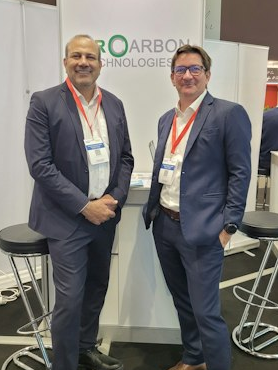
APA press release
A platform to connect industries!
Wien/Hamburg (OTS) - Europa steht vor eng miteinander verbundenen Herausforderungen. Einerseits müssen industrielle Emissionen wie CO₂ reduziert werden. Andererseits benötigt die europäische Industrie langfristig verfügbare und wettbewerbsfähige Energieträger, um ihre Abhängigkeit von Importen zu verringern und Produktionsstandorte abzusichern...
Open source
APA press release
Technologie als Brücke zwischen Energiesicherheit und Klimaschutz
ZCT Solutions integriert Industrieemissionen in die Wasserstoffproduktion Wien (OTS) — Trotz jahrzehntelanger Fortschritte in der Emissionsminderung fehlt der Industrie bislang eine ganzheitliche Lösung für gasförmige und feste Abfallströme. Während viele Ansätze zur erneuerbaren Wasserstoffproduktion auf neu errichtete Wind- und PV-Kapazitäten sowie Elektrolyse setzen und ihre Anlagen unabhängig von bestehenden Produktionsstätten errichten, bleibt eine Herausforderung ungelöst:
Open sourceContact
Consulting starts with an idea
Contact us regarding plant assessment, process engineering or technology integration.